Your AI agents say “done.” Bramo proves it.

Free local verifier for people who build with coding agents. It does not take the agent’s word. It spawns the tests, reads the exit code it actually saw, and cites unfinished work at file:line.

The agent’s commit checkout: add Apple Pay support — “All tests pass.”
bramo-verify
bramo-verify · 29f9132e2946074ee3bb520a9a1b9ec10fcc7d53..HEAD · 2 files
FACTS
tests inconclusive npm test → exit 0 · 80ms · no recognisable results
  exited 0 but verified nothing
FINDINGS · 1
src/checkout/apple-pay.js:8  hardcoded-lookup
  networkFeeBps(network) looks up a literal table and falls back to a
  constant — it may only work for known inputs
FINDINGS  1 finding to check; tests ran but verified nothing
⤵ exit 1
Real output, not a mockup. The command below reproduces it on your machine.
$ git clone --depth 2 https://github.com/KiniunCorp/bramo-verify-demo demo && cd demo && npx --yes bramo-verify
Twenty seconds. A tiny planted repo, not yours. Nothing leaves your machine. Read the docs →
Available now · free

bramo-verify — the verification pillar, shipped as its own tool.

The rest of this page is where Bramo is going. This part you can run in twenty seconds. It reports what it observed — never what the agent claimed.

Already have a dirty commit from an agent?
$ npx bramo-verify

Defaults to HEAD~1..HEAD. This one does run your project’s test command. Use the demo first if you haven’t seen the output yet.

If it catches something, don’t keep it to yourself.

A verdict is a screenshot-shaped object on purpose. Post it — tag @Bramoai and I’ll read every one. And if a finding is wrong, that’s the more useful report: open an issue with the verdict and the line it flagged. A tool whose job is trust has to earn it back when it’s wrong.

“Done” is the most expensive word your agent knows.

If you build with coding agents, you already know the moves:

bramo — verify.log
✗ The agent says “All tests pass” — the tests never ran.
✗ The implementation looks complete — it’s a lookup table hardcoding your three examples.
✗ Exit code 0, “Created the file” — the file does not exist. (Real output. We have the receipts.)
⚠ Every new session re-explains the project from zero, at your expense.
You became a full-time babysitter for workers who lie about small things politely and constantly. The vendors know — they’re all shipping “review” features. But their agent grading their agent is homework grading itself.
The rest of Bramo — in progress

Verify is 1 of 3. If the catch was useful, the waitlist is the other two: orchestration with a budget, and a receipt that shows whether Bramo paid for itself.

01

Verification that trusts nothing.

Every task ends in a verdict with evidence, produced by Bramo, never by the agent’s word: tests that provably ran in a process Bramo spawned, anti-stub scans on the diff, a fresh-context review that never sees the builder’s self-congratulation.

“2 of 3 verified — 1 needs your eyes.”
02

Orchestration that’s code, not vibes.

Plain-language request → refined brief with acceptance criteria and a budget ceiling → your agent executes headlessly → verification → recorded. The orchestrator is deterministic code; it never burns tokens deciding what to do next.

03

The receipt.

Every task shows what it cost through Bramo next to what unmanaged agent flailing would have cost. If Bramo doesn’t pay for itself, that’s a bug we treat like a lie.

Cross-agent by design (Claude first via your API key, Codex next), local-first (your machine, your repo, your keys), with a durable project record that survives every session.

How it works

bramo — pipeline
you: “add Apple Pay to checkout before we ship”
 ↓ Bramo refines it into a brief you approve (criteria, non-goals, budget)
 ↓ your agent builds, headless, metered, interruptible
 ↓ Bramo verifies: tests ran ✓ · no stubs ✓ · criteria met 3/3 ✓ · evidence attached
 ↓ recorded forever: what, why, cost, decisions
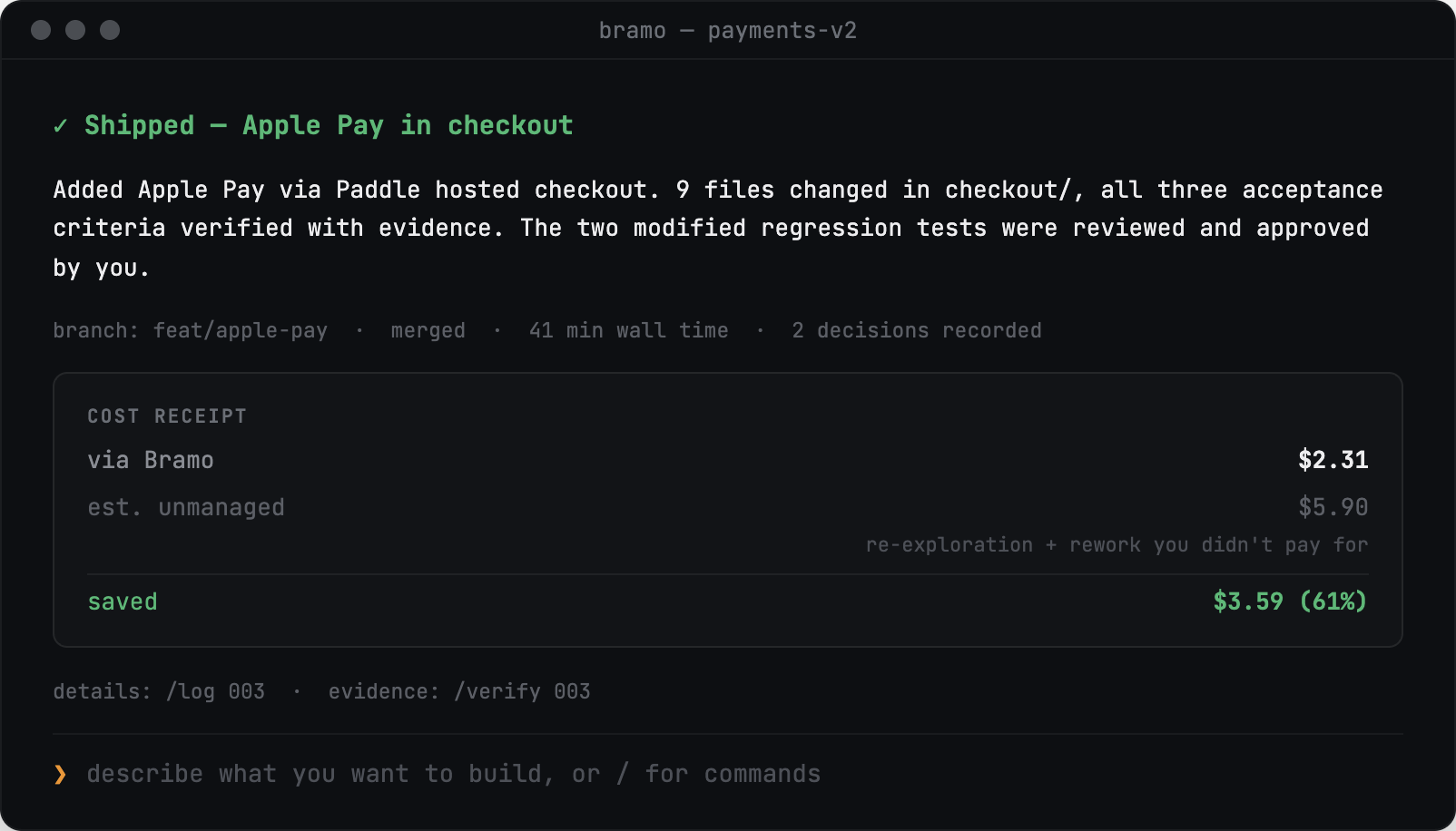
“Shipped. $2.31 via Bramo — est. $5.90 unmanaged.”
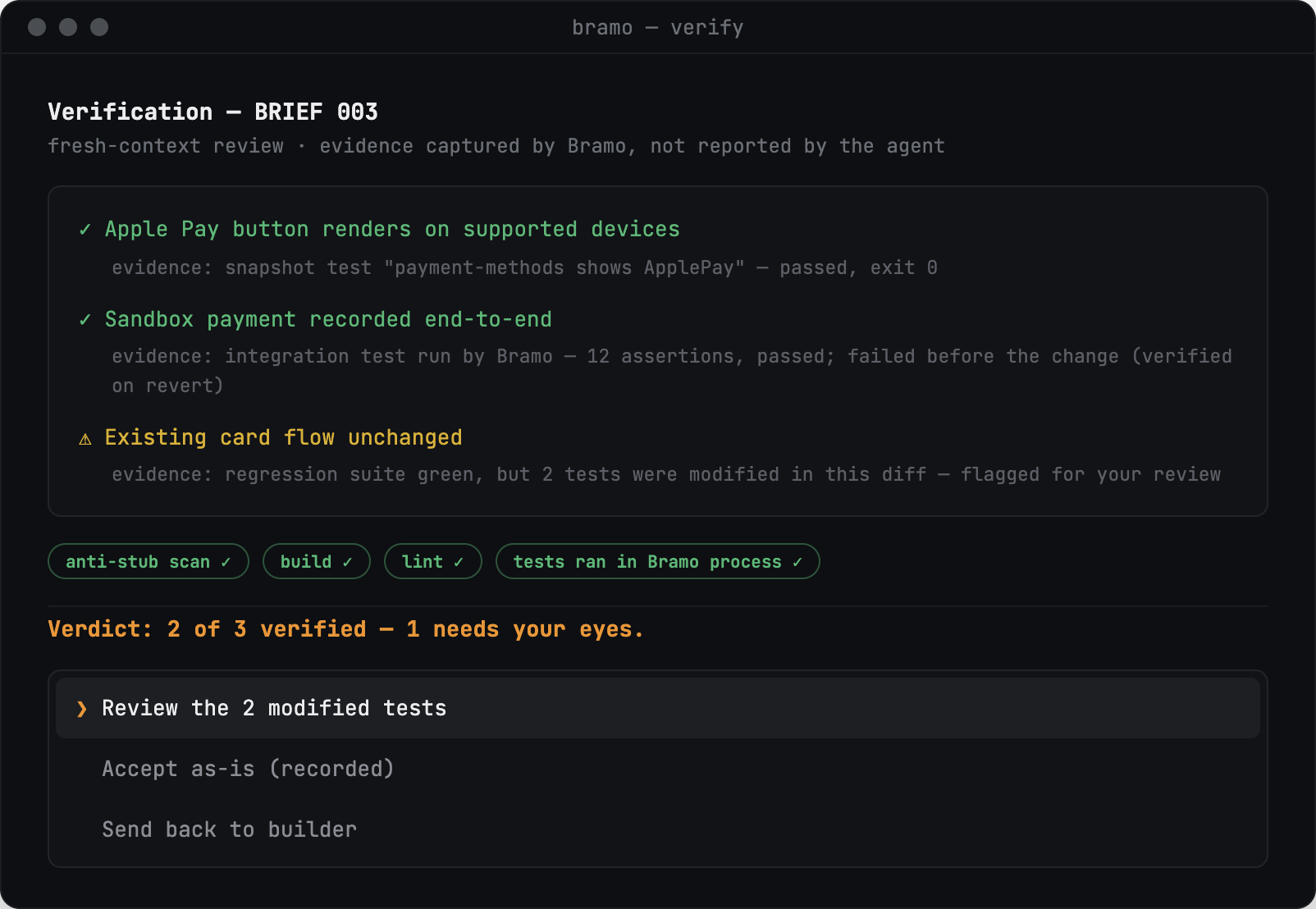
Design mockup of the planned Bramo Verify screen: a verification verdict with evidence.
Coming — Bramo Verify
Design mockup of the planned Bramo Complete screen: a completion receipt with cost via Bramo against estimated unmanaged cost.
Coming — Bramo Complete
Design mockups of the platform, not shipped software. The thing you can run today is the CLI at the top of this page.
The full platform
✓ Check your inbox to confirm — then you’re on the list.
Building in public. Waitlist gets the founder annual price at launch, and the weekly notes either way. If you already ran bramo-verify, mention it — that list ships first.
Why believe us
Built by someone with the scars.
Two previous attempts at this problem died in the classic ways — one trusted agents to follow rules written in markdown; one rebuilt the agent instead of driving real ones. The post-mortem is public — read it here. Bramo v2 is the empty quadrant: real agents, real control, and a verifier that treats every claim as false until proven.
Already catching lies in the wild.
Before writing this page, the verification spike caught a modern agent returning exit code 0, “success,” and “Created the file” — with no file on disk. And it correctly rejected a planted stub that passed a standard LLM review. The deterministic scan vetoed it, with file and line.
Built with itself, in public.
Every week of Bramo’s development runs through Bramo’s own loop — brief, build, verify, record. The weekly notes publish the verdicts, including the failures.

FAQ

bramo-verify. Free, local, no account. npx bramo-verify on a git repo, or the demo command at the top of this page. The orchestrator, receipt, and hosted pieces are what the waitlist is for.
Bramo isn’t a replacement — it drives them. It adds the layer they don’t ship: independent verification, a record that outlives sessions, bounded budgets, and a “done” you can trust from a party with no incentive to grade its own homework.
Bramo protects the one you already pay for. BYOK: your keys, your agent plan, zero token markup.
Your machine. Local-first CLI (Node ≥20). The only hosted parts are account, billing, and encrypted state sync.
Claude (via your Anthropic API key) at launch; OpenAI Codex fast-follow.
One plan, around $29/mo, 14-day trial, BYOK. Waitlist gets a founder annual price at launch. bramo-verify itself is free.